





Halloween offers exciting opportunities for connection, but can present sensory challenges for neurodivergent children. This guide provides practical, ABA-based strategies to help families create a regulated, safe and inclusive holiday experience.
Halloween can be a thrilling season filled with imagination and connection, but it also presents unique challenges for neurodivergent children. Loud noises, flashing lights, unpredictable environments, itchy costumes and unfamiliar social expectations can quickly lead to sensory overload or anxiety.
By using principles grounded in Applied Behavior Analysis (ABA): such as priming, environmental modifications, visual schedules and reinforcement, you can help keep your child regulated whether you are trick-or-treating or attending school events.
Core ABA-Based Halloween Hacks
1. Costume Priming and Desensitization
-
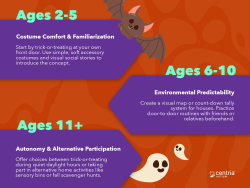
Wear it Early Introduce the costume well in advance. Have your child wear their outfit multiple times before the big day to assess comfort, movement and sensory tolerances.
-
Simplify & Adapt If full costumes are itchy or restrictive, simplify! Pair a soft, comfortable shirt with character accessories like headbands, ears, hats, or simple props.
-
Festive Alternatives If a child dislikes wearing costumes altogether, dress them in a comfortable Halloween-themed t-shirt or accessory instead.
2. Environmental Reframing & Social Priming
-
Refrain and Reframe Unfamiliar or spooky decorations can trigger anxiety. Help reframe scary visuals by intentionally pointing out engaging or funny features (e.g., “Look at those silly lights!” or “What a funny ghost!”) to redirect focus to positive elements.
-
Support Alternate Communication Keep social interactions low-pressure. If your child prefers not to speak, support non-verbal communication and offer positive reinforcement for approaching a door or holding out their treat basket.
-
Practice Ahead of Time Conduct dry runs with trusted neighbors, friends, or family members to help your child get comfortable with the process and expectations.
3. Visual Boundaries and Route Planning
-
Define Fixed Limits The unknown can feel overwhelming. Rather than walking indefinitely, establish a clear expectation ahead of time by deciding on a fixed number of houses to visit (e.g., 5 or 10 houses).
-
Visual Schedules & Tallies Use visual maps or a tally counter on paper or a phone so your child can track progress and visually anticipate when the activity will end.
-
Start at Home Consider making your own front door the very first stop on the trick-or-treating route to build early confidence in a familiar environment.
4. Proactive Sensory Management
-
Daylight Trick-or-Treating Take advantage of early trick-or-treating hours while it is still daylight. This minimizes exposure to dark pathways, strobing lights and overwhelming crowds.
-
Sensory Tools Pack noise-canceling headphones to block out sudden loud sounds, spooky sound effects, or large group noises.
-
Scheduled Sensory Breaks Watch closely for early signs of fatigue or sensory overload. Offer short, planned breaks in a quiet space, such as sitting on a quiet porch step or resting inside the car, to restore energy.
Navigating School Events vs. Trick-or-Treating
School Parades & Classroom Parties
-
Coordinate with Educators Share your child’s sensory profile with their teacher ahead of time.
-
Visual Schedules Request a written or visual schedule of classroom activities so your child knows when transition times, parades, or snack times will occur.
-
Designated Safe Zone Identify a quiet, pre-arranged break area in the school building where your child can retreat if classroom noise becomes overwhelming.
Neighborhood Trick-or-Treating
-
Targeted Outings Focus on quality over quantity. Plan a short, direct route and end on a positive note while your child is still regulated.
-
Reinforcement Provide continuous verbal praise and encouragement for your child’s attempts and participation throughout the evening.
Moving Forward Together
Each individual child has a distinct sensory profile; therefore, it is essential to prioritize their personal comfort over traditional expectations by practicing flexibility, patience and positive reinforcement. Establishing a genuinely inclusive Halloween requires a collaborative effort where family members, caregivers and neighbors work together to cultivate a regulated environment. Implementing minor, intentional modifications, such as reducing light intensity, minimizing volume levels, providing non-edible rewards and supporting low-stakes social exchanges, can significantly enhance the experience. Adopting this proactive, ABA-informed perspective ensures that every child remains regulated, secure and fully engaged in the seasonal celebrations alongside their community.
If you are navigating a new diagnosis or seeking individualized guidance on supporting your child’s social development through Applied Behavior Analysis (ABA therapy), Centria Autism is here to help. Contact our clinical team at (855) 423-4629 or complete our intake form to learn more.